Using References Beyond Realism
It’s so easy to get stuck on copying photos.
Often they already have a lovely composition, strong contrasts, a balance of colors we find appealing. So, halfway through, when we see it coming together, there’s reluctance to lose the photo and turn it into something new.
It just won’t be as good as the photo if we do.
That doesn’t have to be true, but I once had an inner critic that whispered those very things to me.
I felt so satisfied with the certainty of copying my reference: I clearly achieved my goal, or I didn’t. The proof was in easily comparing myself to the original source. It was comfortable. And it felt safe.
At some point I grew dissatisfied with focusing on only the reference. I wanted to challenge myself more, to extend my skill and creativity and have both reflected in the art I made, art that looked uniquely mine. But no one told me how. And if I’m honest I floundered for years trying to find my voice, work with references and make skillful art.
Today, let’s talk about how to use references beyond realism.
We will discuss working from direct observation, photo reference, and from our imagination.
Hey there! 👋 I’m Carrie, and I’m here to remind you: you’re already an artist.
Here on Artist Strong, I help self-taught and returning artists move beyond copying tutorials and references so they can build the skills, confidence, and creative practice to make art that feels like their own.
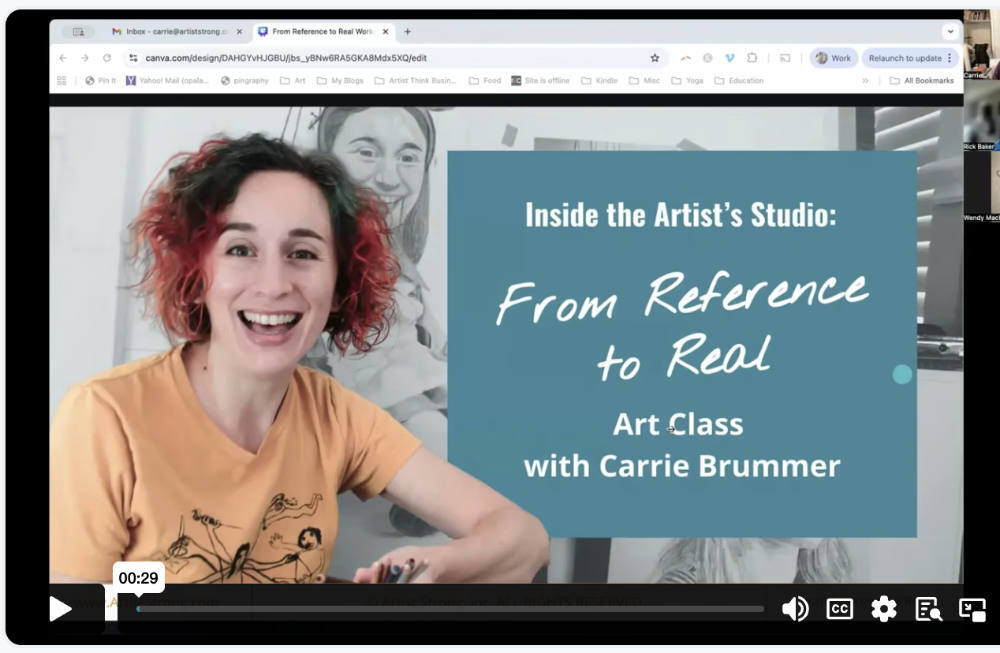
If you’re ready to take that next step, check out my workshop From Reference to Real, where you’ll learn five practical ways to turn image references into your own ideas.
Start with Direct Observation
First, let’s talk about direct observation. Working from observation means you are looking at an object or environment in real life, in three dimensions. You must somehow translate what you observe and communicate through your use of the elements and principles of art on a two dimensional surface, such as paper or canvas. (Yes some artists work in 3D, I’m not discussing this today.)
So how can you stop copying from live references?
I have two student examples for you.
One was attending figure drawing classes and felt bored. They wanted to do something different, so we looked at our work and got curious.
What if she started with a collage surface?
What if she used them as part of the collage backgrounds of other mixed media works?
Another artist focuses on figural abstraction. So she may start with a figure drawing, but then consciously pause to mix and match different figural elements together in a single composition to create something new.
She’s also exploring collaging and cutting up her own sketches to see where it takes her.
What is one thing you might try to mix things up in your next life drawing session? Tell me more in the comments below.
If we stay open, think outside of the box, even the most traditional means of drawing and painting from observation can lead to interesting new work.
What About Photo References?
Now let’s talk about photo references. When I discuss photo references I mean using either photos you’ve taken or royalty free images you have the rights to us as source material for your paintings and drawings.
When the camera was invented, artists thought the world was coming to an end.
Charles Baudelaire, art critic and historian of the time wrote an essay where he said:
“If photography is allowed to supplement art in some of its functions, it will soon have supplanted or corrupted it altogether… it is the sworn enemy of art, and if it is allowed to encroach upon the domain of the impalpable and the imaginary… then woe to us!”

I’ve embedded his whole article on the blog, which is linked below if you’re watching this on YouTube.
Next we have French history painter Paul Delaroche who is claimed to have said, “From today, painting is dead!”
James McNeill Whistler wrote: “The imitator is a poor kind of creature. If the man who paints only the tree, or the flower, or other surface he sees before him were an artist, the king of artists would be the photographer. It is for the artist to do something beyond this.”
Who will want to pay for portraits? Or specific landscapes? When a camera can capture it all.
But it became a tool that supported a new generation of artists who felt permission to start pushing contemporary definitions of art.
The Impressionists sparked a new curiosity: what if we focus on light?
And while they painted en plein air, or on site at a location, they would also take photos to refer back to in their studio.
Smaller studies, paired with photographs, allowed them more time to explore and challenge the day’s definition of art.
Today many revere this genre of art history without fully recognizing how revolutionary and openly disliked it was during its birth and development. It’s easy to dismiss today the major transition this was.
I often think the initial hate digital artists received exploring digital mediums may be reflective of the Impressionist’s experience during their lifetime to try and offer some context to the discomfort and judgement artists were navigating.
So how can you move beyond realism?
I’m going to share some out of the box examples to try to get you thinking bigger.
Try Giving Your Reference to Someone Else
I’ve heard of a few artists (I’m sorry, I don’t remember names) who work with another artist.
So one person starts the work, perhaps from photo reference, then hands it off partially finished.
In one case, the artist had their small child develop the work.
No more matching the photo here!
If you know of any artists who practice and share these approaches please celebrate them by sharing their names and/or websites in the comments below.
Set a Timer
One thing I like to use because it helps me loosen up is setting a timer.
In one mini series, I used 4 x 6 Bristol board and a 15 minute timer.
View this post on Instagram
I had to make quick decisions and decide what I thought was important to the drawing.
And sidenote: those sold really well at my exhibition.
A timer is such a simple way to change your relationship with a reference.
You don’t have time to get every little thing right. You have to make choices. You have to simplify. You have to decide what matters most to you in this short amount of time.
And suddenly, you’re no longer just trying to recreate what you see.
What Could You Try?
What’s something you’ve always wanted to try but feels a bit crazy? Nothing is too big or too small. Tell me in the comments how you will step away from realism in your work if that’s a goal.
Harness the Power of Your Imagination
The last thing I want to encourage you to do is to harness the power of your imagination. What I mean here is to have an idea or a picture in your mind that you try to bring to life on your substrate, like paper or canvas.
Drawing and painting from imagination is something we do pretty easily as children. We just put paintbrush to canvas and made art! In fact, several people commented in a recent video about how easily they did as children and how much they desire to explore in that way again.
One example I love from art history are the surrealists, who explored imagery from dreams. Some came together to play a game called Exquisite Corpse. In this game a piece of paper was divided into three sections. The first artist who drsaw a head and allow a tiny, tiny bit of there marks to extend over into the second or middle section. They would fold back and hide their section and hand it to a new artist, who only had the teeny marks to start from, and they would draw the body. And this process was repeated for the last section, where a third artist would draw legs.
No one knew what they entire artwork would reveal until everyone completed their section.

Think about some of the examples we’ve already talked about.
If you start at figure drawing with a substrate, another word for surface, covered in marks and textures, that creates room for your imagination to play.
If you start and stop the drawing to put different parts together to make something new, hello imagination.
When you stop, when you swap and revisit an artwork someone else has added marks to, your imagination comes into play. How did they change the work? What do you think it needs next?
When you use a timer, you have to simplify and use your imagination to help you finish the work.
Together, your three skills: to draw from observation, to draw from photo reference, and from imagination, is a powerful creative powerhouse that can not only help you make stronger art, but start to clarify and develop your unique style.
My goal here isn’t to suggest any of these activities be siloed either. How can you use all of your skills and ideas in combination to come up with something completely new and entirely yours?
References Don’t Have to Dictate the Finished Artwork
Showing up at a blank canvas without any plan is daunting and often ends with a blank canvas.
But our imagination can go wild and encourage the exploration and play needed to develop our voice when we have parameters that gently and loosely guide the work.
And that’s what references can be too: gentle and flexible guides.
They don’t have to dictate the finished artwork; they can simply give you somewhere to start. They can give you something to respond to, to change, to simplify, exaggerate, combine, cut up, hand off, or completely reinterpret.
The goal isn’t always to get further and further toward matching the reference. What if the reference is simply the beginning?
What Will You Try?
What are other methods you’ve seen artists use to explore that both use references and step away from realism?
Tell me more in the comments below.
If you made it to the end today and found something valuable, you’re a good candidate for my workshop From Reference to Real, where I teach five methods you can explore to step away from copying images and step into your unique voice. It’s $47 and available in both USD and CAD. The link to learn more is here and below.
Thank you so much for watching. Like and subscribe to Artist Strong to never miss an episode. And remember:
Proudly call yourself an artist.
Together, we are Artist Strong.