How to Rekindle Your Creativity as an Artist
In a recent video I talked about the rules and expectations we have around drawing or painting from imagination. And I got this lovely response from someone in the community:

And it got me thinking about the importance of calling yourself an artist, the expectations we place on our growing and learning, as well as how we approached all of this quite differently as children.
So let’s talk about it. How can we rekindle some of that childlike creativity in our lives as adults?
Hey there! 👋 I’m Carrie, and I’m here to remind you: you’re already an artist.
Here on Artist Strong, I help self-taught and returning artists move beyond copying tutorials and references so they can build the skills, confidence, and creative practice to make art that feels like their own.
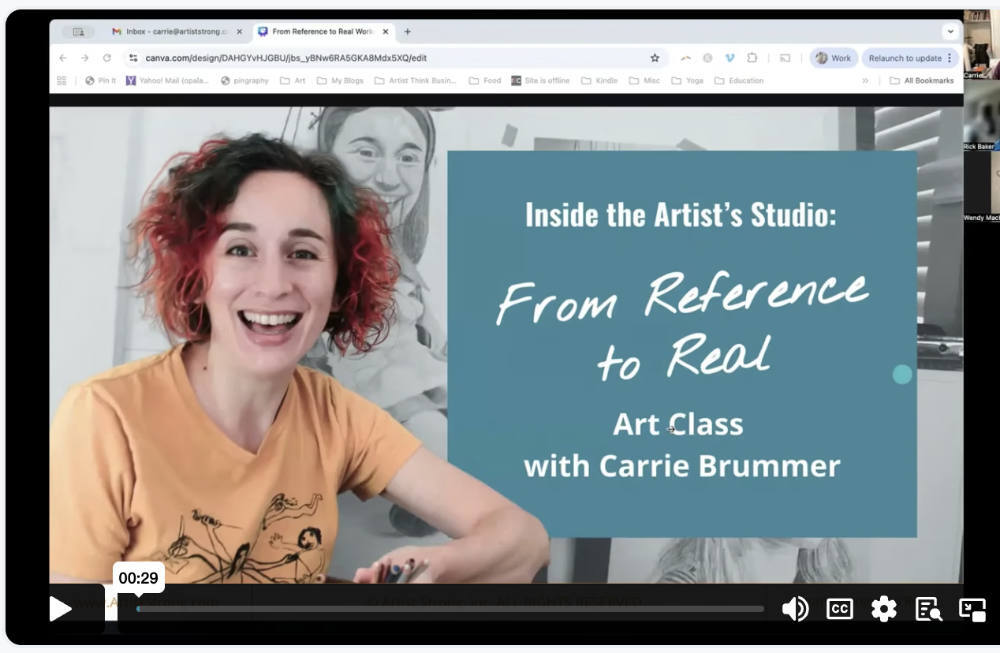
If you’re ready to take that next step, check out my workshop From Reference to Real, where you’ll learn five practical ways to turn image references into your own ideas.
Let’s begin by saying it’s not for me to decide if you are an artist. It’s up to you. I only hope you’re not holding back from calling yourself an artist because of some unspoken definition you feel like you have to live up to.
When we’re children, we don’t start out with nearly as many expectations about what art is supposed to be. We develop those expectations when adults give them to us. We go to school and the teacher tells us our sky has to be blue, or that an animal or person has to look a certain way.
So I think you’re right that the way we approach creating as children can be much more free and open.
There’s no reason, however, that we can’t cultivate some of that freedom in our lives as adults.
You don’t have to create everything from your imagination
There’s an important nuance in your question that I want you to consider.
Do you want the specific skill of combining different objects from your imagination into a scene, or do you want to find new and different ways to get to the same result?
Those are two different things.
You may absolutely want to develop the skill of drawing from imagination. If you do, practice it. Drawing from imagination is a skill, just like drawing from observation or drawing from photo reference.
But you don’t necessarily need to be able to invent an entire scene from your head in order to make artwork that feels like your own.
If you feel like you must do it a certain way, that expectation can interfere with your technique and your ability to realize your goals. That expectation limits your creativity before you’ve even started.
Remember, as children we didn’t set all of these limitations. We looked at things as curiosities and opportunities.
How can you look at this as an opportunity for you to grow and try new things?
One of the things I want you to consider is that there are lots of different ways to arrive at the same result.
You can build a scene without inventing everything from scratch
My most concrete, actionable advice is something I’ll repeat over and over again on this channel: use something like collage to help you plan out your composition.
Too many people want to skip planning, but most of the artists I know spend some time planning their compositions before they jump into them.
This doesn’t have to mean planning every single detail so that it feels like a Paint by Number when it’s time to pull out the canvas.
It does mean thinking about what your main focal point is and what you want to make sure is included on the canvas. You can think about how the different elements are going to work together before you commit to them.
I typically encourage people as well to consider negative space drawings as an activity that helps improve your composition. I have a whole article on how to improve your rules of composition, which I’ll link below.
And collage can be a really wonderful way to experiment with all of this because you can move things around.
You can try something.
You can decide you don’t like it.
You can move it somewhere else.
You don’t have to have the whole thing figured out before you begin.
Sometimes I let the collage tell me what the composition will be
There are a couple of ways to bring different objects together into a composition.
One thing that I like to do is sometimes let my art or collage tell me what the composition will be.
I have this lovely little sketchbook where I fill every page with collage elements anytime I get a chance. The goal isn’t to finish one page at a time. The goal is to figure out which collage piece fits best in which composition.
That means I might flip through 10 or 15 pages of collages before I find just the right spot for something.
And this process leads to finished compositions of work that I never even imagined before I began the process.
I didn’t sit down and think, “Today I am going to imagine this particular finished artwork.”
I started collecting and moving things around, and the artwork revealed itself to me.
The other way I like to work is when I have a specific image in mind, such as my self-portrait as a marionette.
In that situation, I seek out images that I can then incorporate into one larger, rough composition or draft that I then draw and/or paint from.
Both approaches are valid.
You can start with an idea and find the references you need to help you make it.
Or you can start playing with images and discover an idea along the way.
Neither one requires you to magically invent an entire finished artwork from your imagination.
Creativity is a skill, too
Now let’s talk about rekindling creativity.
Creativity is also a skill.
In previous videos, I’ve repeatedly discussed how drawing from observation, drawing from photo reference, and drawing from imagination are three separate skills.
Fostering your creativity is another skill.
It’s about thinking in new and different ways.
So how can we encourage and rekindle the creativity and freedom we experienced as children?
I have a couple of suggestions today.
1. Create a low-stakes environment
If you are already feeling a level of discomfort because you’re challenging yourself, you don’t want to make every step of this process feel too challenging because you’ll give up.
It’s better to create smaller steps that feel more tangible as you try a new process.
This could mean, for example, that if you really like drawing flowers or pet portraits, you keep to a subject matter that you are familiar with.
Don’t start drawing portraits of people if you’ve been painting flowers when you’re trying to create new compositions and develop a new approach to your creative process.
Another area in which you could simplify would be your substrate.
Work on paper that feels non-threatening or inexpensive so you don’t feel like you’re wasting it.
Have a lot of it available, too, so you can make a few marks and be done.
Something my daughter is terribly good at, much to my dismay, is putting a few brushstrokes on a canvas and calling it finished!
Maybe she has something figured out that the rest of us have forgotten.
We feel like we have to make every single piece of our materials count.
That’s just not how art works.
2. You don’t have to make every page count
Look at da Vinci’s sketchbooks, which were filled with thousands and thousands of pages. Much of what he explored never was realized outside of those books.

Sketch by da Vinci
That’s okay.
Perhaps loose paper is less intimidating than a sketchbook.
Or perhaps having a dedicated sketchbook in which the rule is to be messy might be the answer.
For years, I was uncomfortable using a sketchbook because I felt like every page had to be pretty.
It wasn’t until I heard an interview on Windowsill Chats where I heard some artists talk about creating dedicated sketchbooks that I realized something important.
I get to make the rules.
Maybe your sketchbook is where you make beautiful finished drawings.
Maybe it’s where you scribble.
Maybe it’s where you glue things together.
Maybe it’s where you test a colour combination that may never make it into a finished artwork.
The point is to find a way to make the process feel less precious.
What are other ways you can lower the stakes so you don’t feel so intimidated by a new process? Share other ideas in the comments below.
3. Give your ideas somewhere to land
Keep a notebook or make a list of all the ideas you have.
I find ideas come to me at the most random times, and sometimes I just need time to look at an artwork.
I like to take breaks. I have multiple artworks in progress, and I always know what I plan to work on next when I return to the studio.
An idea that I had over five years ago is now just coming to fruition because I feel like I finally have the emotional space and time to put into this exploration.
You don’t have to act on every idea immediately.
An idea can sit there. It can change.
You can come back to it later.
Sometimes the best thing you can do for an idea is give it some space.
Want to Stop Copying and Start Making Your References Your Own?
Today’s article and video are brought to you by my workshop, From Reference to Real.
Inside this 90-minute hands-on workshop, you’ll learn five methods of working with image references that help you stop copying and start stepping into your unique voice.
If you’re tired of copying photo references and want your art to look more like your original ideas, learn more about From Reference to Real by clicking the link below.
4. Pay attention to what makes you want to make art
Also, what do you find fun?
What makes you excited to show up and make art?
Honor those interests, even if someone else has told you they are mundane, they are cliché, or whatever other negative feedback you’ve received.
If it is motivating and exciting to you, that is all that matters.
You don’t have to justify why you enjoy drawing flowers.
You don’t have to explain why you want to make another portrait.
You don’t need permission to be interested in something.
With time, you’ll find that your interests evolve, and that is part of your growth.
You don’t need to worry about growing into the artist you’ll become.
Enjoy the next artwork, the next paintbrush, the next canvas.
5. Use parameters to create freedom
I know several artists who swear by a 30-day or 100-day project.
The commitment to showing up every day becomes the goal rather than having a finished product.
That repetition can create opportunities for you to be more creative and consider many ideas instead of feeling like you have to have a pretty, finished and complete artwork every single day.
Parameters can be helpful.
They don’t have to be rules that tell you that you have to show up a certain way.
Instead, they can be opportunities to foster new ways of looking at your art.
Maybe you decide that for 30 days you’re going to draw the same subject in a different way every day.
Maybe you make a collage every day.
Maybe you work with only three colours.
Maybe you spend 15 minutes making marks and then stop.
The parameter gives you somewhere to begin. It doesn’t have to tell you what the artwork has to become.
And that can be incredibly freeing.
You haven’t lost your creativity
So, how do you rekindle the creativity and freedom you experienced as a child?
I don’t think the answer is to force yourself to draw entire scenes from your imagination.
You can certainly practice that skill if it’s something you want to develop.
But you can also use references. You can use collage. You can move things around. You can make a mess. You can start an idea and come back to it five years later.
You can make bad drawings.
You can put a few brushstrokes on a canvas and decide you’re finished.
You can make a sketchbook where nothing has to be pretty.
And perhaps most importantly, you can stop measuring your creativity by whether you can do something in the particular way you think an artist is supposed to do it.
There are lots of ways to get to the same result.
The question is: which ways make you want to keep creating?
You don’t have to become the artist you think you’re supposed to be.
You just need to make the next thing.
As always, thank you for watching and subscribing to Artist Strong. Your support and participation are why I can create videos like today. Tell me one thing you learned from today in the comment below or a new topic you want covered.
Remember: proudly call yourself an artist.
Together we are Artist Strong.