What Your Brain Has to Do With Getting Better at Drawing From Memory and Imagination
Did you know that your brain filters out a huge amount of the information you take in every single day?
We are inundated with information, both visual and auditory, as well as everything we read. Our brains simply can’t take everything in, especially in today’s digital age of constant information and the easy swipe to watch a new video. So, how does our brain figure out what we should remember and what is irrelevant?
Hey there! 👋 I’m Carrie, and I’m here to remind you: you’re already an artist.
Here on Artist Strong, I help self-taught and returning artists move beyond copying tutorials and references so they can build the skills, confidence, and creative practice to make art that feels like their own.
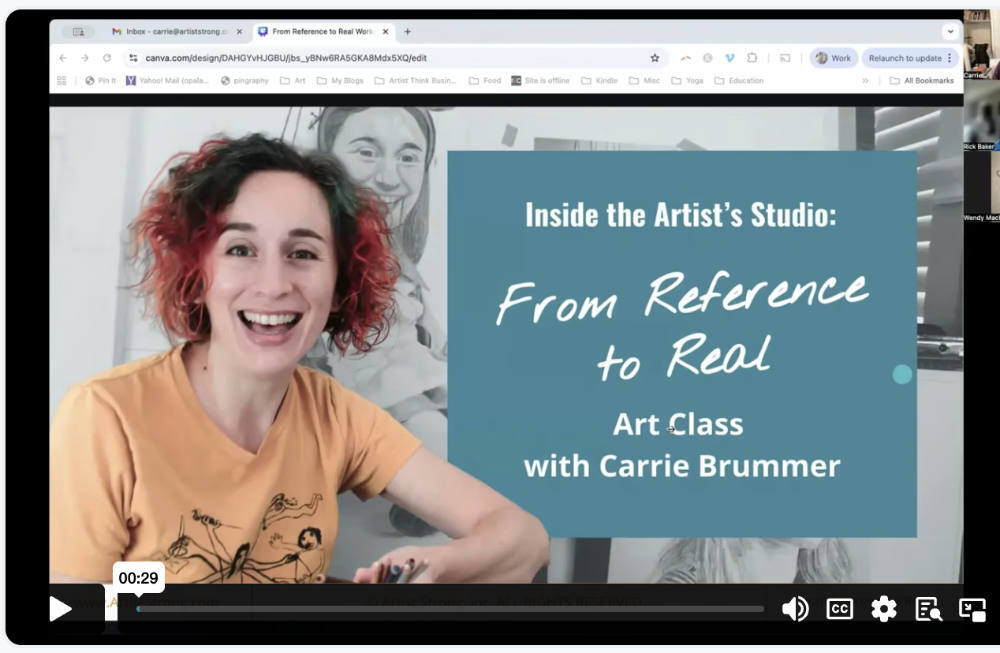
If you’re ready to take that next step, check out my workshop From Reference to Real, where you’ll learn five practical ways to turn image references into your own ideas.
Today’s topic is actually really important to understanding why you might struggle with drawing from memory.
There’s a word for this concept: gestalt. It’s used in psychology to talk about a larger, big-picture idea that reflects a concept. For example, if I say the word dog, you might have a picture of Snoopy, Scooby Doo, or a fluffy black poodle mix like I do. These are all very different ideas of what a dog can mean.
And this concept, this big-picture idea of “dog,” can interfere with the specific information we receive when we observe things.
It’s kind of like our brain has a filing cabinet. When you say the word dog, it pulls up a folder of the things it has decided are most important for you to know about dogs. This may or may not include anatomy, proportion, the structure of the legs, or how to draw fur.
If we haven’t taught our brain, and reinforced through repetition, that knowing this level of detail about a dog is important, we will not have that information fully stored. And of course, this makes it much harder to draw the dog in front of you realistically. It also makes it harder to draw the dog you have pictured in your mind realistically.
Why Drawing From Memory Is a Skill
In my 20-something years of teaching, I’ve known maybe one or two people who could draw realistically from memory. And when I hear people say that their drawings from memory “aren’t that good,” I believe the “good” means realistic.
One of the students loved drawing horses. She spent all of her time around horses, drawing them from observation and drawing them from photographs. When she didn’t have a horse in front of her or a photograph to look at, she would draw and paint horses from her imagination.
That is why she got good at drawing horses from memory.
She couldn’t draw anything she wanted realistically from memory because that’s not what she practiced.
This is an important distinction because drawing from memory is a skill you develop through practice. You are not automatically going to be able to draw anything you can imagine simply because you are an artist.
So what do you actually need to practice if you want to get better at drawing from memory or drawing from imagination?
Three Skills You Need to Develop for Drawing From Imagination
First, you need to develop three different skill sets: drawing from observation, drawing from photo reference, and drawing from imagination or memory.
If you can’t draw from observation or from a photo reference and capture a level of realism, you are going to struggle with drawing from your mind. These skills are prerequisites to drawing from memory or imagination.
Drawing from observation means drawing from a physical object, landscape, person, or animal that is right in front of you and that you can see in real life. This requires a different set of skills than drawing from a photo reference because you are working with a three-dimensional subject and making decisions about what you see in real time.
Drawing from a photo reference means looking at photographs, either photographs you’ve taken yourself or photographs you have legal rights to use, and then replicating parts of or all of the image. Working from photo reference is an important skill for artists because photographs give you access to subjects, poses, environments, and visual information that you may not have access to in real life.
These two skill sets need to be developed in order for you to more confidently draw realistically from your imagination.
Now, thinking back to my earlier story of the girl with the horse, what else do you think is missing? What else do you need to consider?
You need to pick a topic or subject that you wish to be good at drawing from your imagination.
You are not going to magically be good at drawing everything from your mind’s eye or from ideas you have in your head unless you practice them. So, if you know you love painting and drawing flowers, then I would be drawing flowers from life, taking photographs of flowers, drawing from photos of flowers, and then also practicing drawing flowers from my imagination.
The more specific you are about what you want to be able to draw from memory, the more useful your practice becomes.
You Won’t Be Equally Skilled at Everything
There’s another thing you’re going to have to consider here. When you are developing each of these three skill sets, drawing from observation, drawing from photo reference, and drawing from imagination, you will not have the same skill level in all three areas.
If drawing from your imagination is uncomfortable and new to you, it’s likely your skill will not be as strongly reflected in the art you make when you do create it from your imagination.
This is normal.
This is part of the learning process.
And I think this is something artists need to hear more often.
You can be quite skilled at drawing from photographs and still feel completely lost when someone asks you to draw the same subject from your imagination. That doesn’t mean you aren’t a good artist. It means those are different skills.
So my next question to you is: Why do you need to draw from your imagination or memory? What does it prove?
Want to Stop Copying and Start Making Your References Your Own?
Today’s article and video are brought to you by my workshop, From Reference to Real.
Inside this 90-minute hands-on workshop, you’ll learn five methods of working with image references that help you stop copying and start stepping into your unique voice.
If you’re tired of copying photo references and want your art to look more like your original ideas, learn more about From Reference to Real by clicking the link below.
Does Drawing From Memory Make You a Better Artist?
I personally believe there is an unspoken definition of what it means to be a “real artist,” whatever that means, and people create very unreasonable and high expectations of what it means to be a creative human being.
Being able to draw realistically from memory can become one of those expectations.
Maybe you’ve heard someone say that a “real artist” should be able to draw without a reference. Maybe you’ve compared yourself to an artist who seems to be able to pull an entire figure, animal, or environment out of their head. Or maybe you’ve assumed that because you rely on photo references, you aren’t really creating original art.
But I want you to reflect today: What is your definition of being a successful artist? And what do you really want?
It’s pretty silly to waste your time or make an excuse not to show up for something you care about because of some external definition of success in the arts that you may not even believe in.
We internalize these rules without even really understanding them or thinking about them.
I want you to be empowered to make your art.
When my six-year-old daughter and I show up to draw, she’s not wondering if she’s going to be any good. She doesn’t second-guess whether she has to do it a certain way to do it right. And she certainly has no qualms with calling herself an artist.
I don’t either. Because I know my daughter’s an artist. She makes art. There’s something really valuable in that simplicity.
What If You Want Your Art to Look Like Yours?
The biggest thing I see that extends from this conversation is that a lot of creatives say, “I want to make art that looks like mine. I want it to be mine.”
And if that’s really what you want, that’s a very different conversation than being able to draw realistically from imagination or memory.
If your goal is to make your art feel like yours, then I believe there are three things you need to practice: developing a creative practice, developing the skills you need to realize your ideas, and developing your artistic style.
1. Develop a Creative Practice
A creative practice means that you show up consistently and regularly. And I don’t mean it has to be every day.
But if you’re not showing up and making your art regularly, then it’s really hard to feel confident using that label: artist. And it’s really hard to know if any of the art you’re making really does stand out and feel like yours.
You need to make enough art to start seeing patterns in your own choices.
That leads us to the second thing.
2. Develop the Skills You Need to Realize Your Ideas
You need skill. You don’t need to be skillful at everything, however. The question is: What skills do you need to realize your ideas?
Sometimes I have an idea, but I don’t yet have the skill set to make it happen. I will then do the practice work and studying to develop the skills I need to realize the idea.
This could mean that you wish your understanding and communication of form was stronger. If that’s the case, you might need some practice and warm-up time where you focus on form, perhaps through the use of value and light source.
Perhaps you feel more confident in one medium than another. Which medium really best suits the idea you’re trying to communicate? Should you switch to a different medium?
These are the kinds of questions artists get to ask themselves as they develop their skills.
And, as we’ve already talked about, drawing from observation, drawing from photo reference, and drawing from imagination or memory are all skills you can develop. You can become stronger in one area than another, and that’s okay.
The goal isn’t to be equally good at everything.
The goal is to have enough skills to communicate the ideas you want to communicate.
3. Develop Your Artistic Style Through Series Work
The last category I would call important if you want to make your art feel like yours is style.
And one of the best ways I know to develop your artistic style is to create work in series.
When you work in a series, you deepen the research and art you’re making. You dig deeper into the ideas, and you start to understand how your artistic choices are showcasing your unique voice.
When you work in a series, it’s not a one-and-done piece that randomly does or doesn’t connect to previous works. You’re consciously making anywhere from five to twenty-five artworks that stick with either a concept, a medium, a topic… you name it.
There is some kind of connecting concept or material that lets you stick with the idea a little longer.
You can make multiple versions of the same concept and see which piece is stronger. Then you get to ask yourself: Why do I like one better than another?
Maybe you prefer the composition of one. Maybe the color choices in another feel more like you. Maybe one has a particular quality of mark-making that you didn’t even realize you were drawn to.
This is the kind of work that’s going to help you start to recognize what decisions you make that already reflect your art as being your art.
You don’t have to force yourself to “find your style.”
You need to make enough work to start noticing the choices you’re already making.
So Maybe Your Drawings From Memory Aren’t That Good. Who Cares?
I certainly don’t.
It does not reflect on your quality as an artist.
If you want to become really good at drawing a particular subject from memory, then absolutely, practice it. Study that subject. Draw it from observation. Draw it from photographs. Draw it from your imagination. Repeat the process over and over again.
But if drawing realistically from memory isn’t your goal, then I want you to question why you’re using it as a measure of your artistic ability.
What matters more is whether you are making the art you want to make.
Are you developing the skills you need to realize your ideas? Are you showing up consistently enough to actually develop your creative practice? Are you making enough work to start recognizing your own artistic choices? Are you exploring ideas deeply enough that your work starts to feel connected and intentional?
And perhaps most importantly:
Are you giving yourself permission to proudly call yourself an artist?
Because you don’t have to prove that you’re an artist before you can be one.
You make art.
That’s enough.
Thank you so much for reading, and as always, please follow Artist Strong so you never miss an episode. And tell me in the comments below: What was your biggest aha from today’s conversation?
I appreciate you, and I’ll sign off as I always do.
Remember, proudly call yourself an artist.
Together, we are Artist Strong.