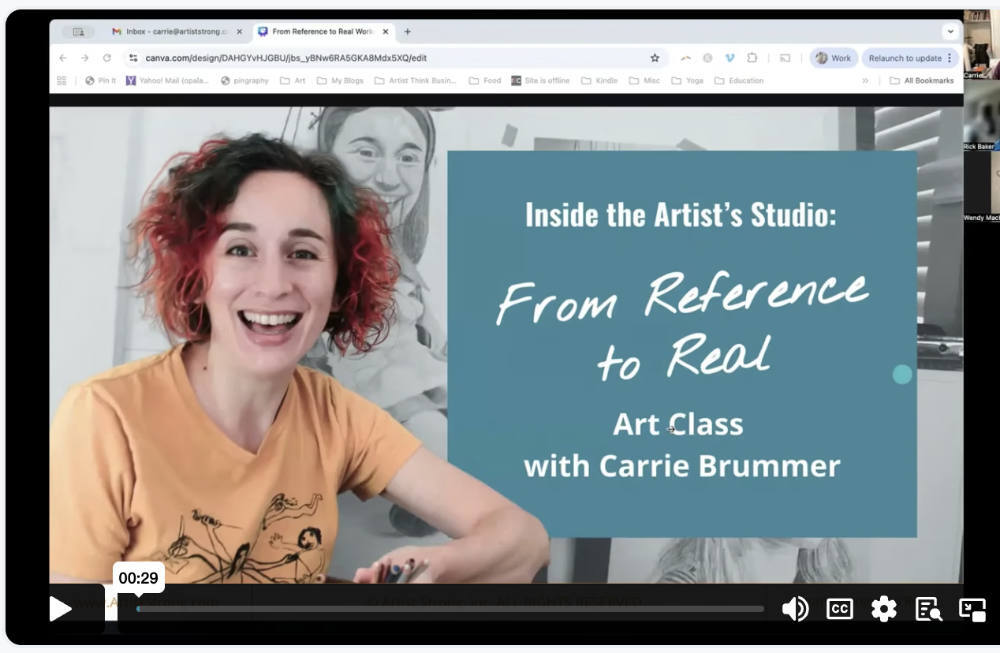
You Don’t Need to Stop Using Photo References to Become an Original Artist
I posted on Threads that “you do not need to stop using photo references to become an original artist.”
While most agreed with me and talked about the extensive records across art history of this…There is a small subset of artists who feel absolutely compelled to say, “Yeah, but…” and insist that drawing and painting from life is superior.
This BS stops too many adult artists who are still learning and growing from showing up. Because if there is a “right” way to make art and they can’t or won’t do it, why bother?
Tell that live-drawing nonsense to someone who paints imaginary creatures, or an elephant when they live far from its natural habitat or any zoo.
Please, please don’t let those little art gremlins wiggle their way into your psyche. If you enjoy working from and with photos, use what you’ve got!
In a recent series, I’m exploring the dynamics of power by placing ICE officers and children in different settings. While painting the piece you see behind me, I thought, what if I made ICE the toy? Like a puppet or paper doll?

So I found old paper doll references to help me sketch out this version. The shape of the doll matches the original, but I then looked at other photos of ICE officers to create the clothing you see here.

In this case, I used multiple photos. I didn’t start and finish with one image. I brought together several images to bring my idea to life.
And that is just one of an endless number of methods or approaches to working with an image reference.
Today, I want to walk through two other ways you can use images as a starting point to communicate your ideas or even come up with an idea in the first place.
Hey there! 👋 I’m Carrie, and I’m here to remind you: You’re already an artist.
Here on Artist Strong, I help self-taught and returning artists move beyond copying tutorials and references so they can build the skills, confidence, and creative practice to make art that feels like their own.
If you’re ready to take that next step, check out my workshop From Reference to Real, where you’ll learn five practical ways to turn image references into your own ideas.
1. Physically Manipulate Your Reference Images
I’m a tangible, pragmatic person. I like to have something I can see in front of me that offers a loose translation of an idea. It helps me commit the concept to canvas or paper.
In one situation, I wanted to draw myself as a puppet. I searched online and used eBay to look for old and antique marionettes. Then I literally pasted my head from a selfie over the doll’s head.

References don’t have to be exact. Creating a crude representation can be a great jumping-off point for beginning to express yourself through your art.
I also physically manipulate photos when I’m in the middle of a work and it needs adjusting.
I thought this piece was unfinished, but I couldn’t quite decide what was missing or where.

After getting feedback from peers, who suggested I add more figures and break up the red space of the barn, I cut out figures and literally taped them onto two different areas of the canvas to help me figure out what would fit where.
Then I painted it in.

Physically cutting up images, moving them around, and combining them can be a great way to problem-solve and explore new ideas.
Try This With a Photo You Love
I encourage you today to find one photograph you’ve wanted to work with and cut out your favorite part.
Where does it belong? What new environment could you put it in? What could you combine it with to create something new?
You don’t have to know the answers before you begin. The point is to give yourself something to play with and see what happens.
I’d love to see the work you make from prompts like this one. Follow me @ArtistStrong on Instagram and tag me in the work you create!
2. Create Multiple Works From the Same Image
Let’s say you love lions. All you can think about is painting, drawing, and sculpting lions. You find one royalty-free image you love and print it out. You paint it, and it’s done.
But you feel this whisper to keep going. To do it again.
Yet you dismiss the idea because you think it’s silly. Who needs two paintings of the same image?
You painted it and it’s done. But you feel this whisper to keep going. To do it again. Yet, you dismissed this is silly because who needs two pinch paintings of the same image?
First off, I challenge you to paint that photo not once, not twice, but 3 to 5 times! You can even start by aiming to copy it. What do you think will happen with each painting, each version of your portrait?
Of course, they will all be a little different! That’s the nature of our human Mark making, it’s not a pure duplicate. I would guess with each interpretation your marks are more confident, loser, because you might even be bored by the fifth attempt, you allow yourself a wee bit more creative license.
The differences in the work in the photo and between works is where your style lives!
I’ll say that again:
The differences between the original photo and your interpretations, as well as the differences between your own works, are where your style lives.
Now, try the same thing, but use only one element from the photo.
Keeping with our lion example, this time you cut out the lion and put it into all kinds of compositions. Maybe it’s walking along a city street, surrounded by other lions in its natural environment, floating in space, or standing on a planet.

Hopefully, you’re starting to see the possibilities here.
Playing in this way fosters your creative thinking and helps you create a starting point rather than an end goal for your work. Instead of treating the photograph as something you need to reproduce, you begin to see it as something you can use, change, and reinterpret.
I want to pause here and ask you: Is this giving you new ideas or perspectives on working with the image reference in front of you? Or maybe you’re feeling resistance and a desire to push back. Tell me more in the comments below.
How to Use Photo References to Make Art That’s Uniquely Yours
Talking about ideas isn’t the same as doing, which is why I created From Reference to Real. I want you to start applying ideas like the ones I’m sharing today to the image references you love.
If you want to make art that feels uniquely yours but feel stuck copying photos, this workshop is for you. Click the link below to get started.
Two Ways to Begin Making Art
I’ve talked about this before, but these methods can work in two different ways.
The first is when you already have an idea and need an image to ground the concept.
You know what you want to make, and you want a plan and images that support it.
The second is when you’re overwhelmed by a blank canvas and have no idea where to start.
You need some parameters and opportunities for play to see what ideas emerge.
There is no wrong way to make art, except stealing other people’s art and claiming it as your own.
If you enjoy working from a place of serendipity, with zero plans, create a process that supports it.
If you enjoy having planned imagery and developing ideas as you begin your work, do that!
And please, please don’t feel like you have to choose one approach. I regularly explore both approaches, and they often inform and feed into each other. Together, they help me make more interesting art.
Let Your Bigger-Picture Vision Inform Your Decisions
One last piece I’d like to discuss today is how your bigger-picture vision can help inform your decisions throughout this process.
I’m thinking right now of a student who wants to honor the natural world through their art: animals, fish, and nature.
If that is an overarching goal, it can help them decide what environments and compositions best support their animal portraits.
Maybe keeping them in their natural habitats as an invitation to the viewer to enjoy the peace and beauty of being in that moment with the animal. Or, maybe placing them all in urban spaces, or outer space, surprises the viewer and get some thinking about habitats and the rules different animals play in the ecosystem.
The bigger ideas you want to express and the values you hold can come through more clearly when they help you decide the first or next steps in your art.
I choose to place people and things in unexpected situations because those surprising environments or contexts can stop us from thinking in our default ways of looking at the world. They invite people into more nuanced conversations.
That is a value, a goal, and a through line for most of my work.
If a message or mission is part of what drives your art, you can work with images intentionally in this way, too.
How You Use References Reveals What Matters to You
Style has six qualities that help an artist make their work their own. For me, messaging and meaning rank higher than, say, my use of color or the quality of my marks.
Look at how you use photographs and interpret them. See this as an opportunity to recognize what you prioritize in your work.
Do you change the context of your subjects to communicate an idea? Are you drawn to certain subjects because of what they mean to you? Do you keep returning to particular compositions, environments, or relationships between figures?
These choices can tell you something about what matters to you as an artist. (There are no “shoulds” here. Except to be true to YOU.)
You don’t have to invent a style or force yourself to be original. You can start by paying attention to the decisions you make, experimenting with the possibilities in your references, and noticing what keeps drawing you back.
The more you understand what you value and how those values influence your decisions, the more confidently you can make art that feels uniquely yours.
And remember, you can use photo references and still make original art. You just need to give yourself permission to do more with them than copy what you see.
What Will You Try?
Is there an activity or suggested prompt that you plan to try today? Perhaps you’ve come up with your own! Tell me more about it in the comments below.
Whether you start with an idea you want to communicate or an image that sparks your curiosity, the goal is the same: to give yourself room to explore, experiment, and make decisions.
You can cut up your references, combine them, paint the same subject multiple times, or use your bigger-picture vision to guide what you create. There isn’t one right way to approach this process. The important thing is that you keep giving yourself opportunities to make choices and discover what interests you.
Over time, those choices start to reveal patterns in your work. And those patterns can help you understand what makes your art yours.
So the next time you find a photo you love, don’t just ask yourself how to reproduce it. Ask yourself what else you could do with it. You might be surprised by where that question takes you.
If you made it to the end today and found something valuable, you’re a good candidate for my workshop From Reference to Real, where I teach five methods you can explore to step away from copying images and step into your unique voice. It’s $47 and available in both USD and CAD. The link to learn more is here and below.
Thank you so much for watching. Like and subscribe to Artist Strong to never miss an episode. And remember:
Proudly call yourself an artist.
Together, we are Artist Strong.