Moving Beyond Copying and Tracing: How to Grow as an Artist
A Brief History of Copying and Tracing in Art
Before we even begin, I need you to understand something: copying and tracing have a long history in art. They are not new, and they are not inherently wrong.
During the Renaissance, artists used full-size preparatory drawings called cartoons to transfer compositions onto painting surfaces. Methods included tracing outlines and using powdered pigment to transfer a design. These techniques helped artists carry their ideas from a drawing to a finished work.
I’ve linked below the images I’m sharing here of some cartoons created and used by Raphael.


And what about photorealism? Artist Audrey Flack, a pioneer of the Photorealist movement, used photographs as the basis for her paintings. In 1969–70, she projected a photographic slide onto a canvas to create Farb Family Portrait, opening up new possibilities for her work.
Tracing, copying, and using photographic references are all tools artists have used to make work. The question is not whether you should use them. The question is whether your current approach is helping you move toward the work you want to make.
Hey there! 👋 I’m Carrie, and I’m here to remind you: You’re already an artist.
Here on Artist Strong, I help self-taught and returning artists move beyond copying tutorials and references so they can build the skills, confidence, and creative practice to make art that feels like their own.
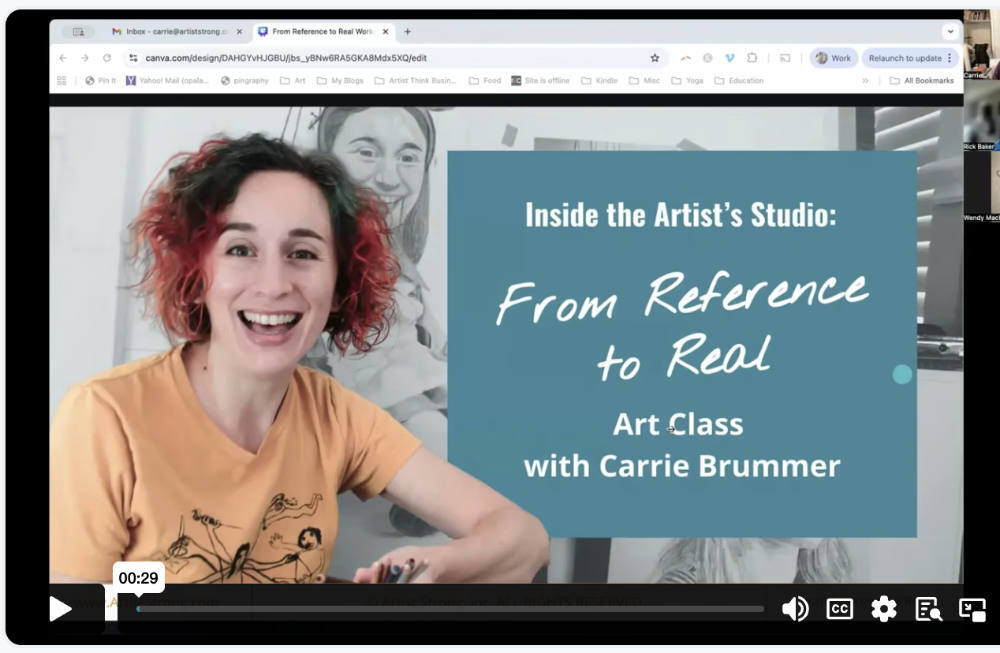
If you’re ready to take that next step, check out my workshop From Reference to Real, where you’ll learn five practical ways to turn image references into your own ideas.
Find it at the link below.
Today let’s walk through 4 steps to moving away from copying and tracing. Not because something is wrong with using these tools, but because you feel curiosity and interest in having even more tools in your creative toolbox.
Step One: Accept That Your Work Might Get Worse Before It Gets Better
One of the most common phrases I hear from students who signed up for From Reference to Real is that they are desperate to move on from copying and tracing.
Before you even begin making, I need you to understand the following: as you challenge yourself to develop new skills, you will see the quality of your work drop. It’s not a sign that anything is wrong, either. It’s a sign you are growing.
I repeat, this is normal!
I have a student who often traces to start their paintings. And heck, yeah, it can be a quick and effective way to move our work along, especially if you prefer the painting.
If they want to draw more freehand and manage to capture a level of likeness, that requires the development of new skills.
I can remember when she stepped away from projecting to do some portraits as part of a life-drawing activity and her discomfort in sharing those studies with me. They did not reflect the same level of detail or value. And that made her uncomfortable.
I loved seeing those little drawings. They weren’t intended to be finished works. And I can see what she observed, what she seems to be drawn to in the things she observes. As a coach and teacher, that’s super helpful information that can help me help her. It’s those little things that start to develop style and voice.
I want to be clear: this is not about shaming or diminishing practices used since the Renaissance. I love when more people show up and make art. We’re making the world a better place.
It’s important to me that you don’t feel stuck and that you see the options available to you as you grow. So, step one is to accept that a drop in skill is inevitable and give yourself the time and space to manage that discomfort.
P.S. now that student chooses to do both and sees both activities and their value (pun maybe intended) for her process and her goals.
Have you ever considered the role of discomfort in your artistic process? Tell me in the comments below.
Step Two: Identify the Skills You Need
Once you accept that developing new skills might feel uncomfortable, the next step is to identify the skills you’re missing and the skills you need.
Are you tracing because you can’t draw or because it’s faster?
Do you copy because it’s fun and you enjoy it, or because your understanding of composition is limited?
All of these things can be true, too!
And there is ZERO shame. I repeat, ZERO shame in using tools that help you achieve results you seek.
I’m not talking about acquiring every skill in this conversation. Instead, it’s about knowing which ones will help you reach your goal and which ones are not currently relevant.
Women often spend too much time trying to acquire all the skills and all the credentials before they give themselves space for step three. In fact, with the perfectionist students I have, I’d rather you worry less about having all the skills. It can become a tool of avoidance and procrastination. We only need to identify those skills and be working on them before we step into the next phase.
You don’t need to master everything before you start experimenting. You need to understand what you want to learn and begin working toward it.
Step Three: Enter Your Artist-as-Scientist Era
In science, researchers test theories through experiments. They guess what the answer might be, but accept what the data tells them.
I’d like you to think of yourself as an artist-scientist.
Instead of thinking of your next five or ten works as finished artworks that should be exhibition-worthy, think of each one as an experiment.
Go in with a hunch about how it might turn out while remaining open to the new possibilities it might show you. Repeat experiments. Try new experiments until that spark of inspiration and motivation tells you which pieces you want to fully develop.
In the beginning it will be hard to hear that inner artist guiding you because your art gremlin is way louder. That requires the patience and practice of listening, too.
So, Carrie you ask, what are those experiments?
This is when you can refer back to different classes you’ve taken or collected.
What if you collage and paint over elements?
What if you spent ten artworks studying anatomy and the placement of facial features?
What if you get your favorite photograph you’ve ever taken and draw it ten times?
The experiments you can create are limitless. It’s up to you and your imagination. I can already hear some students in my mind here saying to themselves: but I’m not creative. That’s why I’ve offered the parameters above. Creating parameters gives you some structure to stretch those creative muscles and get better and stronger using them.
This is how style shows up and tells you about your own art.
Testing ideas you’ve learned in classes or observed from artists across art history can be a wonderful resource for ideas and approaches, these are parameters, too!
You might discover that you love working with a limited palette. You might find yourself drawn to exaggerated proportions, unexpected compositions, or combining materials in ways you hadn’t considered before.
The point is to give yourself the space to find out without the constant pressure of a perfect, finished artwork.
How could you approach something you’ve wanted to try as an experiment? Share your “hypothesis” in the comments below.
You Don’t Have to Give Up References to Make Original Art
I hope you see in all this conversation that I didn’t suggest you lose image references forever and only draw from observation. Or from your imagination.
I don’t stand for art school snobbery, and if that’s your take, Artist Strong is probably not the place for you. Black-and-white, didactic thinking comes from a place of perfectionism that can actively limit our creativity. Don’t let the evil art gremlins tell you otherwise.
You can use photographs, draw from observation, work from your imagination, trace, collage, or combine several approaches. These are all options available to you.
The goal isn’t to follow a set of rules about what makes art legitimate. Instead let’s understand your choices and have more of them available to you.
Step Four: Be Patient and Give Yourself Time
This is not an overnight activity, and just like I tell my students in From Reference to Real, you may want to repeat certain experiments with different images or completely different ideas.
Let yourself make work you don’t like. Let yourself make work you don’t finish because you already learned what you need to. And let yourself have fun!
I mean, isn’t that the whole point? The joy and magic we feel in both the making and the sharing of the work?
What Will You Try?
I’d love to know which parameter you will explore this week. While I talk a lot in these videos, the real goal is get you making! Tell me what you plan to work on in the comments below. This world is a better place with you making art in it.
If you made it to the end today and found something valuable, you’re a good candidate for my workshop From Reference to Real, where I teach five methods you can explore to step away from copying images and step into your unique voice. It’s $47 and available in both USD and CAD. The link to learn more is here and below.
Thank you so much for watching. Like and subscribe to Artist Strong to never miss an episode.
And remember:
Proudly call yourself an artist.
Together, we are Artist Strong.