How to Move Beyond Copying Tutorials and Create Art That Feels Like You
“I have problems making my art ‘mine.’” That’s what I thought as I wandered through art classes in high school and even studied art and art history at university. It’s like I was missing some secret sauce that would magically reflect in my art, make it stand out and shine. I’d finally be like one of those artists in my history texts: move away from realism to my own personal style, something that feels authentic rather than following a trend.
Unfortunately, I was operating on a bunch of false premises that made me even question calling myself an artist. A lot of them had to do with using photo references.
If you’re here, perhaps you’re now interested in doing more than just reflecting what you see in a photo. But when you show up in front of that blank canvas without a lesson or a photo, it’s daunting.When you try, your skill feels like it’s disappeared overnight. Don’t worry: this isn’t a sign something is wrong with you, or evidence you should quit. It’s something bigger and better: it’s a sign you’re learning something new.
Hey there! 👋 I’m Carrie, and I’m here to remind you: you’re already an artist.
Here on Artist Strong, I help self-taught and returning artists move beyond copying tutorials and references so they can build the skills, confidence, and creative practice to make art that feels like their own.
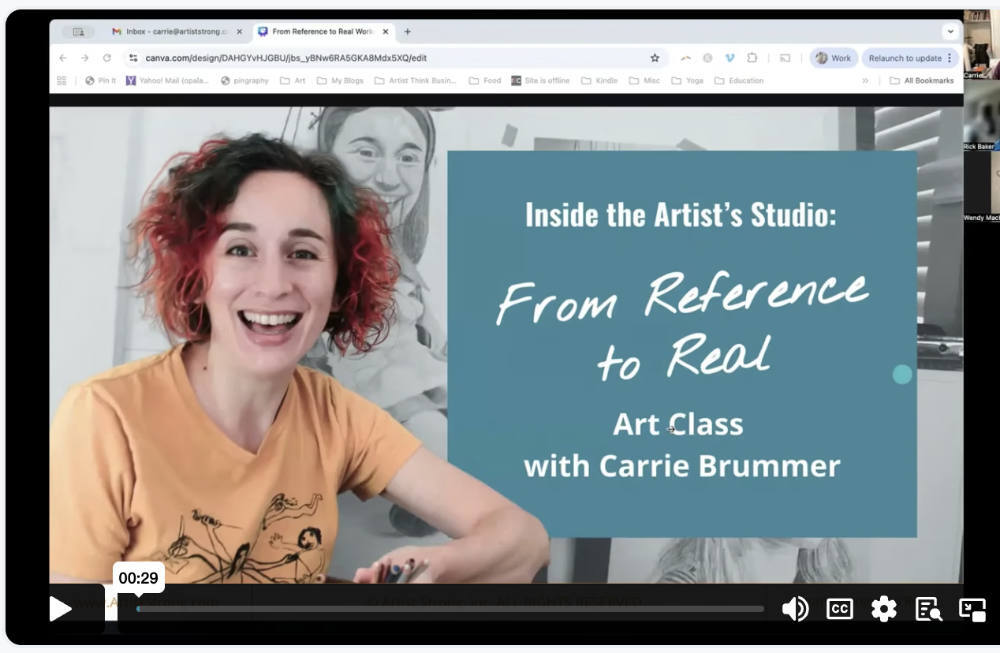
If you’re ready to take that next step, check out my workshop From Reference to Real, where you’ll learn five practical ways to turn image references into your own ideas.
Today, let’s discuss 3 misconceptions artists can have around using references and 3 ways you can start using them to make your art more unique.
References aren’t meant to be copies.
I’ve heard one phrase over and over again and for some reason, this one really gets on my nerves. It’s, “that’s why we have a camera!”
I know people have good intentions saying it: that our art isn’t meant to match a photograph, that our art is so much more than copying, but for the longest time my goal was to copy a photograph. It was how I could prove to myself I was a “real” artist, because it demonstrated skill.
In fact, most self-taught artists I know and work with have started in exactly the same way. They’ve found photos they are inspired by, and try to create an artwork that matches the image reference.
I remember comparing my art to the photo at the end, judging every area where I “missed” something. It became a measuring stick for my skill as well as my so-called authority and experience to call myself an artist.
I couldn’t hear that we didn’t need to copy. What else would I do?
High school was the first time I remember hearing I should have my own style to be a “real” artist. Man I tried. I created a series, I tried exploring unique ideas, but my skill dropped dramatically. I stopped using image references because, of course, that was cheating. And I don’t recall any teachers giving me any kind of feedback or structure that would have helped me better communicate my ideas. I should just practice more, or come up with a new idea.
I didn’t realize I image references could help me communicate with a level of skill
I just didn’t (and don’t!) have when I tried to create from my imagination. I didn’t realize those are different skills to develop, that when used together, create stronger art.
Relying on references is a weakness.
Have you ever heard the idea or unspoken definition that “real” artists draw and paint solely from their imagination? (My hand is up, here).
As I just explained, there are 3 different skills to develop as an artist.
(1) Drawing from direct observation, which means observing things in real life and drawing or painting them on paper.
(2) Drawing from photo reference, which means using photographs or other 2D imagery to help you create your art. And (3) Drawing from imagination, which means being able to draw and paint without using (1) or (2).
Here’s the thing. Developing one skill doesn’t immediately promise you will be good at all three. They are different skills. So if you want to be good at any one of them, or all of them, you need to practice doing all three!
Countless artists from art history have used references. Chuck Close, Claude Monet, Amy Sherald, Audrey Flack, even Renaissance artists would make art from their own drawings.
I have ZERO clue where this imaginary rule came from. But too many creatives feel shame around working with image references when they are an important and valuable tool for artists to communicate their ideas.
You should face the blank canvas and just create
Imagine this: you show up to your pristine studio space in your home full of creative inspiration and energy. Paints are out and ready so you step up to your blank canvas and just… create.
I think we romanticize this idea that we should magically download ideas and images in our mind and communicate them on canvas. It’s why people hold an unspoken standard of drawing realistically from their imagination.
And while there are many artists whose process works with this idea of showing up and jumping into a blank canvas, there are just as many who require some planning and preparation.
Renaissance artists did life size preparatory drawings they would then trace on walls for their frescoes. Countless artists I know draw out their compositions before they begin. And even en plein air painting requires you to consider your composition before you start; many create guiding lines or shapes to help place the composition.
Has one of these misconceptions been niggling at the back of your mind? Or perhaps I missed one that has held you back from showing up for your art. Tell me more in the comments below.
The gap between tutorials and your original art
Relying on photo references as well as learning with tutorials are valuable steps to building skill and confidence as an artist. At some point, you might start to lose the excitement and validation that comes from these activities. Both offer you a level of certainty: you had a model to work from and you matched it! Look at you go. That feels great for a while because you are challenged by it, you are learning new things. But eventually, you start to hear a whisper: How do I “create-like-me?”
You feel frustrated because you’re pretty decent at replicating images (drawing and painting) but they’re reproductions, not “yours.” Yet adding your ‘own’ imaginings is limited and feels uncomfortable. Not to mention the fear of messing it up gets larger especially if you’ve invested a lot of time.
Here’s the thing: copying photos and tutorials create a certain level of comfort. And this is important when you’re developing new skills, because learning is uncomfortable.Let me repeat that for emphasis: learning is uncomfortable.
People forget that part. And it’s almost unspoken that being comfortable with our skill is a sign of mastery and ultimately, success. We did the thing! But, if you want more from your art, you have to get uncomfortable again, because say it with me people: learning is uncomfortable.
There is a sweet spot of discomfort that really helps with mastery: too little discomfort and you’ll see your growth slow, too much discomfort can turn us away from the work we want to do. Research backs this, I’ll link to an article where I talk more about that here.
So let me be clear: In the 30 years I’ve been drawing and painting, the discomfort has never left. What has made me uncomfortable has changed. That’s what you’re experiencing as you begin to move away from copying and step into creating. That discomfort is not a sign of your failure: it’s a sign of your growth!
What do you do after the tutorial ends?
This is where I want to offer you 3 different ways to start using references to help you in this uncomfortable transition. Because there are endless possibilities when it comes to using references to help you create your art. But you need to TRY them to ultimately know what you enjoy and what keeps you excited for more.
Reading and watching this video isn’t the same as doing. And the way to internalize and apply the lessons today is by creating. Let’s walk through 3 strategies you can test this week. I’d like you to choose one after we discuss them and tell me which one you choose and give yourself a deadline.
Collage your reference
Collage is one of my favorite low pressure activities that has helped me create countless work. Personally I will collage together different elements to create my original work. One example of this is I had the idea to draw myself as a marionette. So I cut and pasted two images together, which you can see here:

I gridded it to help me lay out the composition and then began drawing:
Then, I drew my portrait with this photo for inspiration and guidance. This is the finished work:

Collage on your substrate
I also know of artists who collage directly on the surface of their canvas and then paint over them like guides or preparatory drawings. The goal isn’t to match the image perfectly, but to have a starting point for anatomy, for example.
Here I’m exploring the use of this for my latest series questions how power and authority really work. I place ICE officers in children’s spaces, to ask who gets to feel safe. Here is a recent work:

So, for one of my next works, I want to create a painting of an ICE officer blowing bubbles. So I’ve photographed my husband blowing bubbles for my starting reference. Blowing it up and gluing or tracing it on the canvas, I can more accurately place the helmet and other gear.
The image continues to be a starting point instead of the end goal.
Digital collage
When I was taking classes on writing and illustrating graphic novels, we were taught to use digital collage to piece together compositions before we drew them (either digitally or physically).
I’d loosely sketch out the story, they look for images and figures posed in the right way for me to collage together for each composition. Sometimes I did a digital drawing after and from those images, other times I’d paint it out.

I’d love to know: which example today has you feeling a sense of possibility? Choose one to explore this week. Tell me which one, how you will use it, and when you will finish your experiment in the comments below. I don’t want you sitting in hypotheticals, I want you in your studio (yes the dining room table counts) creating!
If you’ve made it this far, you’re a good candidate for my workshop From Reference to Real, where we actively explore five methods to step away from image references so you can step into exploring your original ideas. Learn more and visit artiststrong.com/from-reference-to-real, which I’ve also linked below.
Don’t paint like me, paint like you.
It’s easy to avoid the discomfort of learning and growth. Fight the belief that to be uncomfortable means we are doing something wrong. It’s the exact opposite: discomfort is a prerequisite to growing and improving.
So this gap you’re experiencing: between the skill and confidence that copying photos and tutorials has helped you grow, and the confusion and discomfort about what to do next is normal. It’s part of evolving as a creative, and you can do something about it.
You can use image references as a jumping off point. And while you test and experiment with today’s strategies, or the strategies inside my workshop From Reference to Real, you are going to have a bunch of uncomfortable, partially finished drawings and paintings. That is how you learn, test new ideas, and iterate. Not every piece is meant to be hung on a wall. And when you are going through this transition it’s normal to even see a drop in skill. Don’t fret: it’s not forever. It’s just part of the process.
If you enjoyed today’s video, please like and subscribe to Artist Strong. Your support is why I can create videos like this one. Once you’re done, tell me in the comments one thing you’ve learned today that you can use this week in your art.
As always, thanks so much for watching.
Remember: proudly call yourself an artist.
Together, we are Artist Strong.
Dear Carrie,
I’m amazed I found you on YouTube with your tutorial on Richard Diebenkorn. I went to art school during the Bay Area movement in the 1980s at San Francisco State University and studied extensively Diebenkorn and with Robert Bechte.as my teacher.
. I’ve been doing art for 50 years since then and my medium was silk painting for 20 years. Now I’m trying to work on paper and I’m lost. I sold my work in galleries in the Southwest and at shows Intuitively I feel the pull of Diebenkorn as main artist that I was exposed to in school.
II feel lost now working on paper cause I worked on silk for a long time and I even thought I could learn from someone which seemed so unusual for me her name is Art with Adele(with a huge following) and it didn’t seem authentic to me even though I like her work I guess I could go on and on but I’ll go in and look more at what you have I’m really glad I found you thank you !
Sincerely and best wishes Laura Quilligan
Laura welcome! What a lovely comment to find today. 🙂 What an amazing connection you have to Diebenkorn and Bechte. Transitioning from silk to paper is a big change! Remember that the discomfort you feel is because you are learning something new (or remembering it) and that adjustment is always uncomfortable. Thank you for taking the time to comment here I’m so happy to have you now part of Artist Strong <3