At the time of this writing, there are so many crises in the world that we share a responsibility to address, from famine in Gaza, Mali, and Sudan, to political strife and climate emergencies. And so often, this makes creatives feel like they shouldn’t make any art at all. In fact, I’ve had questions like, “shouldn’t I be spending my time doing something more useful?”
So, if the world’s on fire, why should we make art?
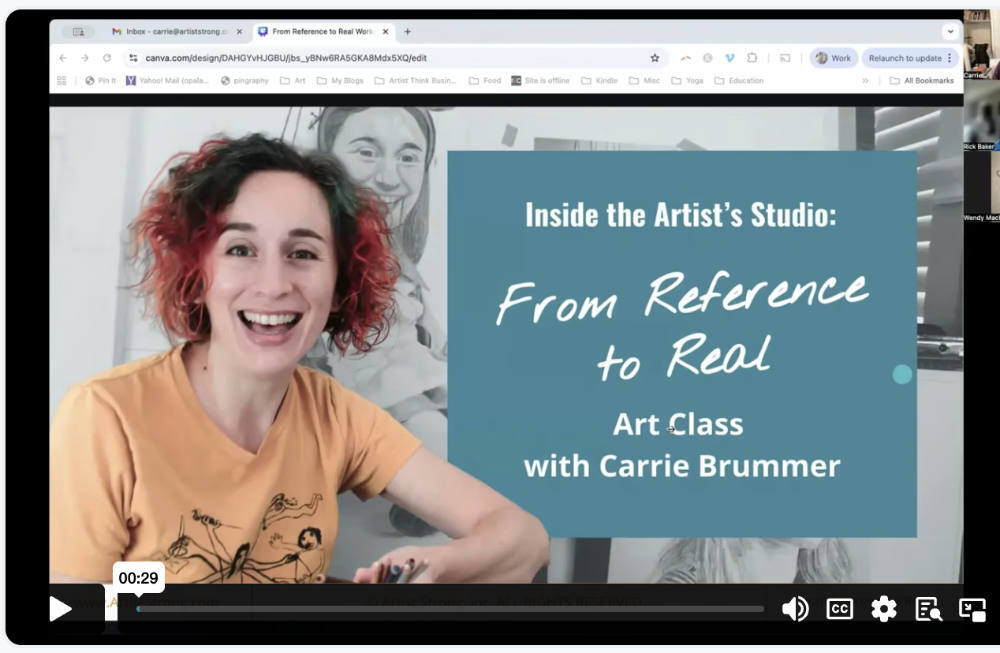
Hey there! 👋 I’m Carrie and I’m here to remind you: you’re already an artist.
Here on Artist Strong, I help creatives stop feeling like a copyist or hobbyist, so they can create their first real series of artwork and start building a portfolio they’re proud of.
If you’re ready to stop the DIY learning and get the support and structure to finally draw and paint with your unique voice, I’m here to help.
Sign up and watch my workshop, How to Transform Your Ideas Into Artwork That’s Uniquely Yours. To date, thousands have joined the community. The workshop is completely free, and the link is in the description below.
Making Art is Useful
I want to tell you today that making art is useful. Not only useful, but necessary.
There are so many reasons to make art, but the one that’s personally most important to me is knowing our ancestors, before written language, before stable homes, before reliable access to food, they still made time for art.
It is a mark of humanity to be creative. And I feel such a well of emotion when I see these prehistoric works and imagine their lives, and how they had to make time and space to create.
I have so many privileges. I have a place to live, I have regular food on the table, I have access to healthcare. And I know many of you watching probably can relate. And yet we still prioritize doing our laundry over making our art. That’s not quite as urgent as finding a food source, but we choose it over our art.
Do you think you’d feel greater urgency to create when times are tough or do you think it’s even harder?
Art is useful for both the creator and those who view it. And today we’re going to discuss the many ways art improves the world we live in.
Making Art Prevents Violence
Research by Dr. Stuart Brown found a direct correlation between lack of play in the lives of children and their later acts of violence as adults.
Brown’s research shows what happens when play and creativity are missing: we add fuel to the fire. In his landmark study of young men imprisoned for murder, Brown discovered almost every one of them had severely play-deprived childhoods, compared to non-incarcerated peers. Without outlets for creative play, frustration and trauma festered, later erupting as violence. (source).
On a societal level, Brown argues that cultures lacking in spontaneous, joyful play face higher rates of interpersonal violence and crime. (Taking Charge of Your Wellbeing)
These findings suggest that creative play isn’t just for fun: it builds emotional resilience and helps prevent violence.
I think about this one a lot because hurt people hurt people. It makes me wonder: if all children had true access to play, which includes creative expression, would we be where we are right now?
I only know one way we can change that… which is to make more art! As adults, we can model and encourage this in our children, our grandchildren and other adults in our lives. Because what is more impactful: telling those you love to make time for their hobbies, or making time for your own?
Additionally, we can support and invest in arts and other play programs for all ages.
Making Art Keeps Us Healthy
Additionally, medical research has shown there are physical and mental health outcomes when we dedicate time to a creative practice.
Numerous studies show the mental and physical wellness advantages of engaging in creative practices:
- A 2025 arts-based intervention showed that participants experienced significant improvements in general health and psychological well-being, though no impact on competence was noted.(ScienceDirect)
- The U.S. National Endowment for the Arts reports that arts participation helps children build emotional resilience, and in older adults, slows cognitive decline, improves mood, communication, and flexibility.(National Endowment for the Arts)
- The Adobe Foundation and NAMI surveyed nearly 2,000 people and found that among those engaging in creative activities:
- 63% reported improved confidence in their abilities,
- 61% said it eased stress and anxiety,
- 57% noted better overall mental well-being.(NAMI)
- Medical sources also affirm that creative arts therapy: through modalities like drawing, movement, and other expressive techniques, can positively impact well-being, emotional resilience, self-esteem, communication, and quality of life.(Mayo Clinic Press)
Creativity heals. It builds confidence, reduces stress, and nurtures mental health.
There’s a metaphor we’ve all heard: if your house is on fire, you can’t put out the flames next door until you’ve dealt with your own.
Art is one way we care for ourselves. It’s putting on a life vest for yourself first. It gives us mental space, healing, and resilience. That doesn’t mean we avoid hard conversations or disengage from causes we care about. It means we recognize that constant burnout and self-denial make it harder to show up for anyone else.
Taking care of yourself is a radical act. And making art is one way to do just that.
This does not mean avoiding hard conversations or not doing some of the uncomfortable work that might be involved in dissent or supporting a cause you care about. I don’t think we should be using our need for rest as an excuse to avoid the hard topics of our time. And I’m saying this specifically through the lens of a white woman who is granted a lot of comfort.
What I am saying is if we constantly place pressure on ourselves so that we are drowning in expectations it’s gonna be really hard to show up for much of anything at all. Perhaps those unrealistic expectations are part of the systems helping us all play a little too small.
Art as a tool for social justice
Now I want to talk about art as a tool for social justice. A lot of people seem to put the standards on themselves that suggest if their art isn’t overly political or about social justice themes, then it’s not very worthy.
I’m here to argue that making the art that you feel called to create, that isn’t dictated by a market, or by any “shoulds” that you feel in your life, is way more radical than overtly making political art.
When we choose to live our lives out loud, which come with many diverse expressions of living, that changes the world.
You have two ways to make an impact with your art. First, by being an example: simply showing that you make time for creative expression. Second, through the work you share: how you choose to share it and what you choose to do with it. In fact, you don’t have to change much at all. You can use the art you already make as a tool for positive change.
When I think of this, I think of a wonderful artist I know named Shae. She isn’t making overt political statements with her work. Instead, she creates art from her heart, art rooted in her unique voice and ideas. It’s through this authenticity, in developing her own style and exploring what she feels called to create, that she’s able to make a real impact in the lives of others.
For example, Shae has a beautiful series of pigeon portraits, inspired by birds she or people she knows have rescued. These paintings have been incredibly successful; she even landed a major commission recently. What makes it even more powerful is that part of her ethos is giving back: she donates a portion of the proceeds from these works to a major bird rescue organization. This choice reflects her values and her commitment to ensuring we don’t let the world burn while we make art.
Tricia Hersey, known as the Nap Bishop and founder of The Nap Ministry, redefines rest as a form of resistance. Through immersive workshops, performance art, and collective napping, she creates sacred spaces that reclaim rest as healing and justice, in direct opposition to grind culture, capitalism, and white supremacy. (FLUX PROJECTS, The Nap Ministry, Wanderlust)
Her book Rest Is Resistance invites us to embrace rest as an act of liberation:
“Rest, in its simplest form, becomes an act of resistance and a reclaiming of power because it asserts our most basic humanity. We are enough. The systems cannot have us.” (Thirdeyebag, MahoganyBooks)
In the context of art and creativity, taking time to rest is foundational, not an indulgence, but a radical necessity for sustainability.
Big Changes Start Small
Sometimes it feels like the problems of the world are too big for our small efforts. But small actions add up.
Every time we silence our creative urge because someone once told us other things are “more important,” we diminish part of ourselves. Saying yes to our art is saying yes to our humanity.
If we all ignore our desire to create and push down things that we’ve always wanted, but dismiss because society, teachers, parents, sisters, whoever, has told us other things are more important, we’re part of the problem.
You shouldn’t have to hide or ignore part of who you are. No one knows you better than you know yourself.
Don’t underestimate the ripple effect of following that call. Angry people hurt people. But healed people, creative people, and connected people? They help build peace.
So, why should you make art when the world is on fire?
Because art is one of the ways we put the flames out.
Seek Connection
Another example I think of is teacher and artist Mary Coffey. She hosts Creative Resistance classes that invite people to show up and make something, anything, in community. It’s not about perfection or even producing a finished piece; it’s about the act of gathering, creating, and being witnessed.
The science supports it: creating in community amplifies the mental health benefits of art. Connection itself is healing. When we gather, make, and share, we not only help put out some of the “fires” in our own lives, we also model a different, more sustainable way of being for others.
And connection doesn’t stop at the studio door. Engaging with other people’s art can spark just as much healing and belonging. Recently, I visited the Kelowna Art Gallery to see Ekow Nimako’s exhibition Building Black Civilizations: Journey of 2,000 Ships.
The show is stunning: entirely built from black LEGO bricks, Nimako reimagines a speculative history in which 2,000 ships sailed from Africa to the Americas, not as a story of slavery, but as one of Black ingenuity, resilience, and thriving civilization.
In this exhibition, Nimako reinterprets an enduring and often overlooked legend: Mansa Abu Bakr II, the predecessor of Mansa Musa of the 14th-century Mali Empire, is said to have abdicated his throne and set sail with a fleet of 2,000 ships into the Atlantic, never to return. Some accounts speculate the fleet may have reached the Americas, but what happened remains a mystery.
His monumental, intricate sculptures—built from over half a million black LEGO bricks—depict landscapes, seafaring vessels, and architectural forms that evoke both historical reference and vivid imagination. And they invite us to connect with histories too often erased and to imagine a future shaped by creativity and strength rather than oppression.
Standing in that gallery, I was struck by how art can hold both grief and hope, both memory and vision. It reminded me that engaging with the creative work of others isn’t passive, it’s an act of connection that can cool the flames of disconnection, despair, and historical erasure.
When we choose to create together or witness art that tells stories, we are dampening the fires of isolation and hopelessness. We are choosing connection over division. And right now, that might be one of the most radical acts of all.
Small Acts Against the Flames
When we skip art because laundry feels more urgent, or when we dismiss our creative voice as unimportant, we let the fire spread unchecked.
But every time we create, every time we consider our health, every time we make a mark, a note, a stitch, we take a small step toward extinguishing despair.
It may not look heroic. It may not make headlines. But just like Shae painting her rescued pigeons, or Mary Coffey holding creative resistance classes, each act adds to the collective wave working to put out the fire.
Thanks so much for watching. If you enjoyed today’s topic, please like and subscribe to Artist Strong. And tell me something new you’ll use in your art practice in the comments below.
Remember: proudly call yourself an artist.
Together, we are Artist Strong.
Something new and unique I use to create my art and show people more of what is good than what is evil. As artists we need to create something inspiring not frightening. Something good not evil, and something right and not wrong. Art speaks to the heart and mind of people that desire to see something unique and new to not only them but to others. As a visionair I paint draw and sketch what I see in my dreams. If I see something scary, I exclude it from my visions. I mostly teach physically disabled people how to create their own unique art by listening to the Holy Spirit, and through nature with has a lot to do with what I am creating. I added it as new because it was new to me when I first started creating art. Carrie, I enjoy what you write, and it has helped me better my technics that they become more real. I pray you are doing well. May we both continue to be ARTIST STRONG.!
Thank you Carl. 🙂
Your writing has struck so many chords with me! I relate to so much of it! Thankyou and thankyou again for refreshing my hope.
Adele I’m so glad to hear it. Making it refreshed mine. I’m so glad it can help you, too.
“Saying yes to our art is saying yes to our humanity.” Thanks so much for this video, Carrie.
Thank you Shae for being you <3