
When Thinking Too Much Is Stopping Your Art
How to Stop Overthinking and Start Creating Again
If you overthink your art, you’re not broken.
You’re not undisciplined.
And you’re definitely not “not meant to be an artist.”
You’re thoughtful. You care. You want your work to mean something. And somewhere along the way, that care turned into pressure.
Overthinking often shows up dressed as responsibility:
- “I should know what this piece is about before I start.”
- “I need to choose the right medium.”
- “If I’m going to spend time on this, it should be good.”
But instead of protecting your art, all that thinking quietly shuts it down. Hello, perfectionism.
Let’s talk about what’s really happening, and what to do instead.
Hey there! 👋 I’m Carrie.
I am here to remind you of something important. You are already an artist.
Here on Artist Strong, I help creatives stop feeling like copyists or hobbyists and start creating their first real series of artwork, work that reflects who they are and what they care about.
If you are ready to move beyond DIY learning and want the support and structure to finally draw and paint with your unique voice, I am here to help.
You can sign up for my free workshop How to Transform Your Ideas Into Artwork That Is Uniquely Yours. Thousands of artists have already joined the community and the workshop is completely free. You will find the link below.
Why Artists Overthink (and Why It Makes Sense)
Most artists who overthink aren’t beginners.
They’ve:
- Learned enough to see what’s not working
- Absorbed rules, frameworks, and opinions
- Developed taste faster than confidence
So now, every blank page feels like a test.
Overthinking is often a sign that you’ve moved from play into evaluation too early. Your brain wants certainty before your hands have gathered information.
Perfectionist tendencies want to fight against creative process. They whisper thoughts like, “you should know exactly how it’s going to turn out,” or, “you need more skill before you do x, y, or z.”
But art doesn’t work that way.
Art reveals itself through doing, not before.
👉 Pause and reflect:
Do you tend to wait until you “feel ready” before starting?
Drop a “yes” or “definitely” in the comments if that hits.
Strategy #1: Separate “Making” From “Meaning”
One of the fastest ways to stop overthinking is to stop asking your art to explain itself upfront.
Instead of:
What is this about?
Try:
What happens if I follow this line for five more minutes?
Give yourself explicit permission to make work that is:
- Incomplete
- Unclear
- Experimental
- For your eyes only
Additionally, I encourage you to create specific times for both creating and assessment. Looking at and assessing our work can help us become better artists. But creating boundaries around the two activities, and more importantly separating them, helps stop the spiral of overwhelm. I’ve got an oldie but goodie blog post about this linked here.
Action you can take today:
Set a timer for 15 minutes and make something with no intention beyond starting. No theme. No explanation. No future audience.
When the timer ends, stop, even if it’s “working.”
This builds trust between you and your process.
👉If you struggle to let art exist without a meaning, comment “permission” below. You’re not alone.
Strategy #2: Use Constraints to Quiet the Noise
Overthinking thrives on too much freedom.
When everything is possible, your brain panics.
Constraints aren’t limitations: they’re relief.
Try choosing:
- One medium for a week
- One subject for five sessions
- One size of paper
- One tool you’re “allowed” to use
This removes dozens of decisions before you even begin.
Artist Strong reframe:
Constraints don’t make you less creative.
They give your creativity somewhere to land.
When I created my Anonymous Woman series, I started with 4×6 pieces of bristol board and a 15 minute timer. I knew I wanted to explore the photo references I stumbled upon, but I was overwhelmed by the newness of my idea, worried about my ability to capture likeness, and more.
I did those 15 minute drawings just to warm up and get me thinking about composition. I had no intention for them to be anything more. And they did create momentum for me to start larger works. The great irony is I ended up putting them in the exhibition and they were some of my best selling pieces.
👉 What’s one constraint you could commit to this week?
Comment with medium, subject, or time limit.
Strategy #3: Replace “Is This Good?” With Better Questions
Overthinking usually circles one exhausting question:
Is this good?
That question is a dead end.
Try replacing it with questions that keep you moving:
- What feels unclear here?
- What am I avoiding?
- What part of this has energy?
- What happens if I exaggerate instead of fix?
These questions turn judgment into curiosity.
And curiosity is fuel.
I’ve recently started exploring some new ideas in my art that I’m not quite ready to show yet. They are new for me, I’m not sure if I have figured it out yet, and they are overtly political, which completely activates my nervous system. I’m second guessing myself daily. I constantly hear in my head: “Is this any good?”
Most of the discomfort I’m feeling right now about the work is because I lack clarity and direction. I have this concept I’m curious about, and I need to explore multiple iterations of this idea and observe the work that comes from this experimentation before I’ll know if it’s coherent and worth continuing. I need faith that my curiosity will guide me to my next series of art. And when I focus on that, I stop wondering if it’s any good.
The only way I’ll get the answers I seek is by creating art.
Practice this:
Write your new go-to question on a sticky note and keep it near your workspace. When you feel stuck, ask that instead.
👉 Which question feels most helpful right now? Comment with the one you’ll try.
Strategy #4: Shrink the Stakes (Way Down)
Many artists overthink because every piece feels like it has to:
- Represent their skill
- Prove their seriousness
- Justify the time spent
- Point toward a future body of work
That’s an impossible load.
Not every piece is a portfolio piece.
Not every session needs momentum.
Not every artwork needs to “count.”
Artist Strong truth:
Your practice grows through volume, not perfection.
There is a story in the art ed world that regularly makes the rounds: it’s about a ceramic professor who divided their class into two groups. Group A was told they could use as much clay as they wanted and to make as many, let’s say teapots, as possible. Group B was told to make one perfect teapot to hand in.
Can you guess which group felt more agency, had more permission to make mistakes and experiment?
And who do you think made the better teapot?
Try intentionally making:
- “Throwaway” drawings
- Studies no one will see
- Work on scrap paper
- Pieces you don’t sign
The goal is to practice being in motion.
👉 If lowering the stakes feels scary but relieving, drop a 🙋♀️ in the comments.
Strategy #5: Build a Near-Daily Relationship With Your Art
Overthinking loves long gaps.
When too much time passes between sessions, the pressure builds. Art becomes a performance instead of a relationship.
Consistency doesn’t mean hours.
It means contact.
5–15 minutes most days is often enough to:
- Stay connected
- Reduce fear
- Keep ideas moving
- Build self-trust
Try this:
Create a “minimum practice” you can do even on busy days:
- One page
- One mark
- One small study
Anything more is a bonus.
I’d like to share honestly here for a moment: after finishing a few pieces during my many moves in 2025, I lost the momentum of making art most days. It’s been months now since I’ve finished anything and while I’m dabbling, without the consistency of showing up and periodically finishing work, my confidence has waned.
I know what I need to do. And I’ve started some new work, but to keep momentum, I need to return to my near-daily practice.
When you have your hands in your art, and life gets in the way (and trust me, it will), it’s way easier to return to the bigger ideas you have when you have maintained a practice.
And it doesn’t matter how many years of practice you have, or your skill level, I find this true for artists at all levels.
👉 What’s a realistic minimum practice for you right now? Comment it, it helps make it real.
Strategy #6: Let the Work Teach You What You’re Interested In
Many artists think they need to decide their direction.
But clarity usually comes after repetition.
When you make a lot of work, patterns emerge:
- Subjects you return to
- Marks you enjoy making
- Questions that keep resurfacing
Your job isn’t to figure it all out.
Your job is to pay attention.
Artist Strong mindset:
Your art already knows more than you think.
You discover it by showing up.
I used to think I should have my ideas fully developed first and then make my art. But now I see when I explore my ideas through making, I gain better clarity; I feel more confident about which work I want to finish and explore more deeply and which art and ideas were only a stepping stone to the next.
👉Have you noticed any patterns in your work lately? Share one in the comments.
If You Overthink, It Means You Care, and That’s Not a Flaw
Overthinking isn’t something to shame yourself out of.
It’s something to redirect.
Each time you:
- Start before you feel ready
- Choose constraints
- Ask better questions
- Lower the stakes
- Show up again
You’re building creative confidence the honest way: through experience.
And that’s what Artist Strong is about.
Not forcing clarity.
Not waiting for certainty.
But choosing your art again and again.
Final question for you:
Which strategy are you going to try this week?
Comment below; I’d love to hear.
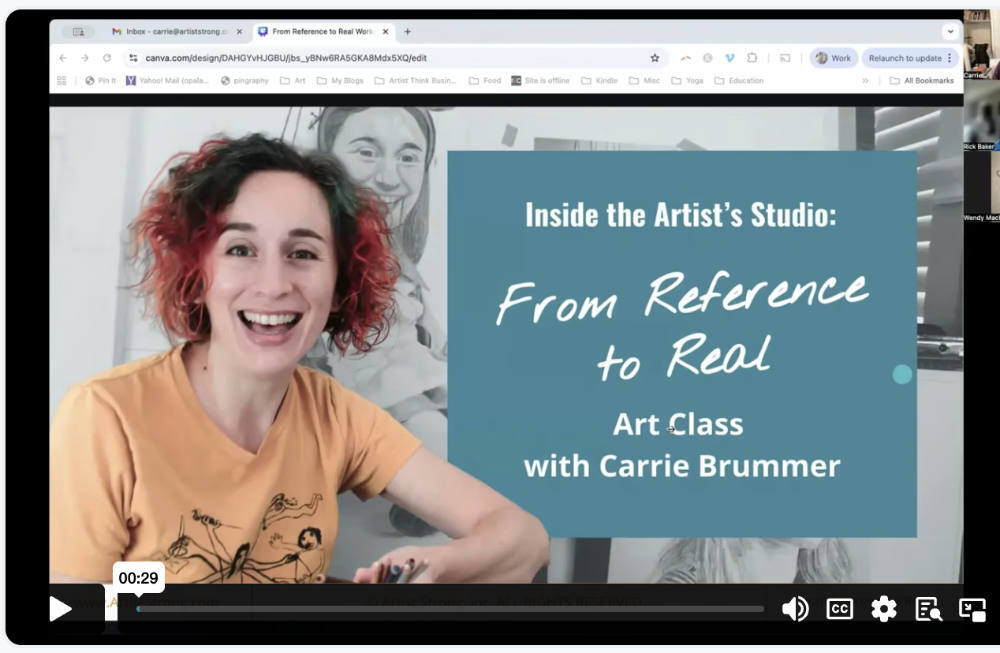
Thanks so much for watching, please like this video and subscribe to Artist Strong to not only catch our weekly content but also help decide our content: your interests and questions direct the content I create.
Remember: proudly call yourself an artist.
Together, we are Artist Strong 💛
Remember Karen Carpenter’s song “Killing me softly with his song”? Well that is the song you are singing to me in this blog. I am going to print it so I have it closely at hand. Now to start doing and stop over thinking it. Karen
Hugs to you Karen. Together we are Artist Strong <3 <3 <3
This was so good for me to hear! I’ve been moving towards being less restrictive and more “go with the flow” and your comments reinforce this for me. I’m currently working through new materials I’ve received through an art supply subscription service. I find myself not giving myself permission to use them in new ways beyond what was suggested. Your presentation helps me to let go of that!
Thomas I love everything about this comment. Have fun! Use up those materials and stay curious 🙂 Thanks for being here.
Thank you so much Carrie! I love all the blog posts you’ve been sending lately but this one really is the best for me. Overthinking has been crippling me these past couple of years because illness and neck injuries really set me back. I have everyday so when Im having a better day I feel like I really need to “perform” and not “ruin” my watercolour paper. Written in black and white here I see how ridiculous that is but psychologically makes so much sense. Thank you again for your helpfulness and dedication to your blog.😊💐
Sylvie thanks SO much for being here. I’m so glad this is helpful! And you’re welcome, I love being Artist Strong with people like yourself. 🙂
Hi Carrie, Thank you so much for all your thoughts and understanding why some artists get stuck/trapped, and also many ways to move forward. My inner critic was telling me why paint? no one cares or sees what you do at your age. Then one day LOL, that day i told the critic to get out; picked up some scrap paper, wrote some action verbs on about 10 pieces of the same size folded. I tossed them into a bag. i wrote paint a fish, draw a b/w landscape, do nothing, read about your fav artist, collage a face, etc etc. and BINGO, i picked one from the bag, and thought i can do that. it got me moving again, having fun, and laughing at my critic.
Mary I love this so much!! Thanks for sharing your strategy for getting unstuck; I’m CONFIDENT it will help others. And just in case you need to hear it: you have NO idea who might be touched by either your choice to create or the work you do create. Your choice to make art makes this world a better place! Thank you <3
Thank you so much Mary!
Thats a great idea beyond a list of prompts that is created. The physical action of picking out of a mixed bag you created and the element of surprise makes it more of a tangible and fun process. Thanks again for motivating me to do the same. Lastly, ee most definitely have to talk back to our inner critics that stall us and keep is stuck.
Wishing you the best to you and your creative journey.
Totally second what Sylvie says here 🙂
THANK YOU FOR THE HELPFUL WORDS. They are insightful!
Thanks for being here Sheryl!